
Health and Safety for Small Businesses: A Practical Guide for UK Employers
If you run a small business in the UK, health and safety law applies to you. There is no exemption based on size, sector, or the number of people you employ. Whether you are a sole trader, a partnership, or a limited company with a handful of staff, you have legal duties to protect your employees and anyone else affected by your work.
The good news is that for most small businesses, compliance is straightforward and affordable. You do not need a dedicated safety officer or a shelf full of manuals. You need a basic understanding of your obligations and a practical system for meeting them.
This guide covers the essentials.
Your Legal Duties as an Employer
The Health and Safety at Work Act 1974 is the main piece of legislation covering workplace safety in the UK. It requires every employer to ensure, so far as is reasonably practicable, the health, safety, and welfare of their employees at work. This duty also extends to other people who might be affected by your business activities, including customers, visitors, and members of the public.
The Management of Health and Safety at Work Regulations 1999 build on this by requiring employers to carry out risk assessments, appoint a competent person to help manage health and safety, provide information and training to employees, and make arrangements for emergencies.
If you employ five or more people, you must have a written health and safety policy and written risk assessments. If you have fewer than five employees, you are still expected to carry out risk assessments and manage safety properly — you just do not have to write it down (though doing so is strongly recommended).
Risk Assessments
A risk assessment is a systematic look at what could cause harm in your workplace. You identify the hazards, consider who might be affected and how, evaluate the level of risk, and decide what measures to put in place to eliminate or reduce the risk.
For most small businesses, the risks are predictable: slips and trips, manual handling, display screen equipment, fire, electrical safety, and stress. The assessment does not need to be complicated, but it does need to be specific to your business and reviewed whenever something changes.
For a step-by-step walkthrough, read our guide on how to conduct a risk assessment for your business.
If your business carries out higher-risk activities such as construction, maintenance, or manufacturing, you may need more detailed documentation in the form of risk assessments and method statements. Our RAMS service provides tailored documents for any trade or sector.
Health and Safety Policy
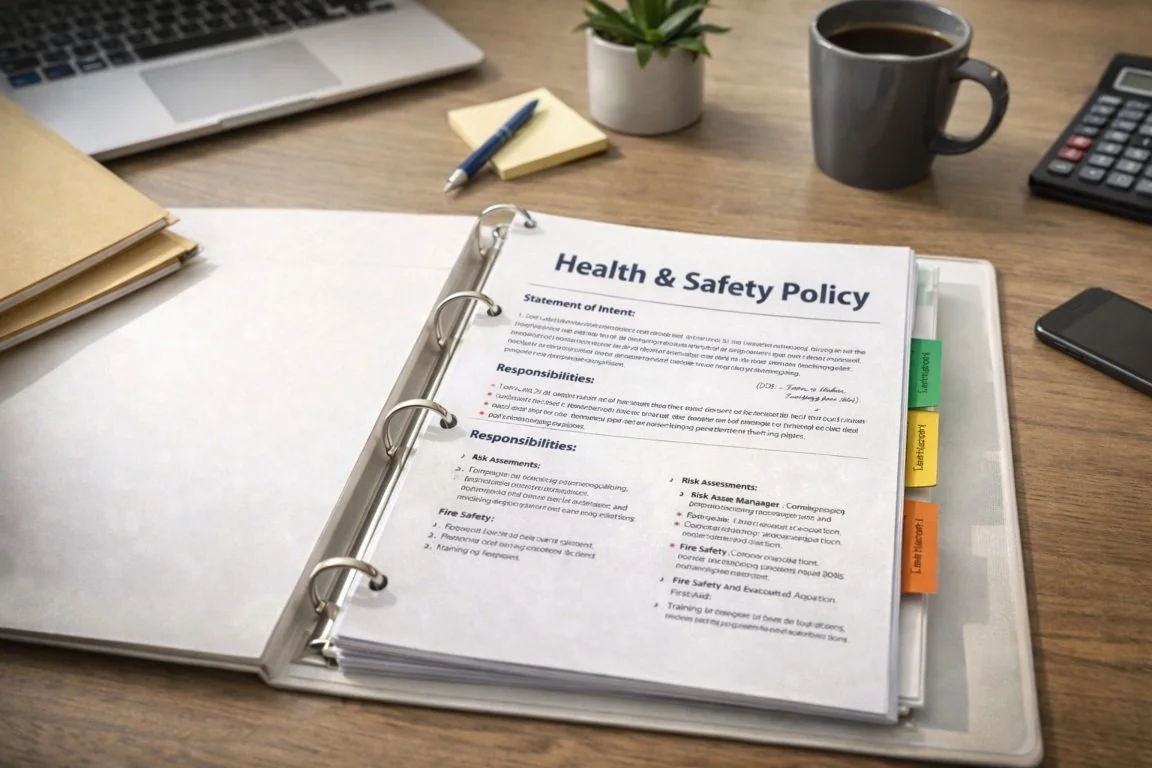
If you employ five or more people, you need a written health and safety policy. This document has three parts: a statement of intent signed by the most senior person in the business, an organisation section explaining who is responsible for what, and an arrangements section describing the practical systems you have in place for managing safety day to day.
Your policy should be reviewed at least once a year and updated whenever there are significant changes to your operations, staff, or premises. If you need help creating or updating your policy, our policies and handbooks service can produce one tailored to your business.
Fire Safety
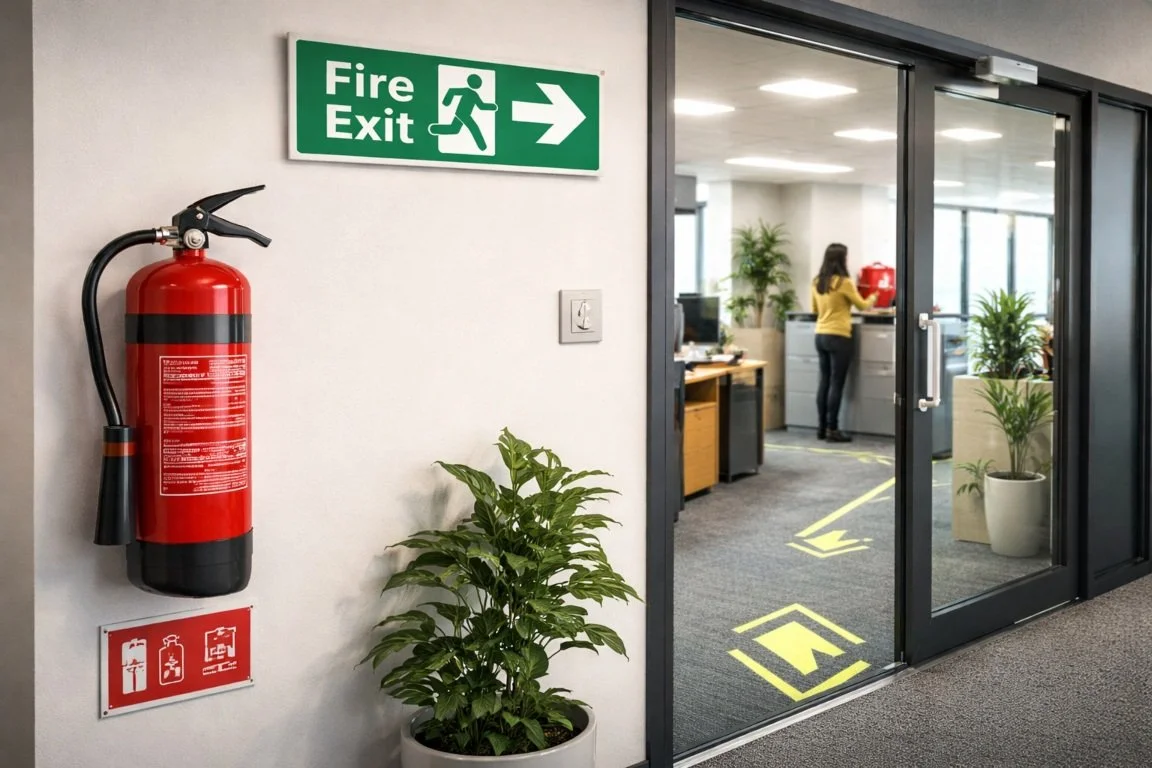
Every UK business operating from non-domestic premises must have a fire risk assessment under the Regulatory Reform (Fire Safety) Order 2005. This applies regardless of the size of your business. Even if you work from a shared office or co-working space, the responsible person for the premises must ensure a fire risk assessment is in place.
Common requirements include having working fire detection and alarm systems, maintaining clear escape routes, providing appropriate fire extinguishers, displaying fire safety signage, training staff on evacuation procedures, and carrying out regular fire drills.
If your fire risk assessment is missing or out of date, our fire risk assessment service can help you get compliant.
Training
Employers must provide adequate health and safety training to all employees. This includes induction training when someone starts work, job-specific training for tasks that involve particular risks, and refresher training at appropriate intervals.
Training does not have to be formal classroom sessions. For many small businesses, a structured toolbox talk, a one-to-one briefing, or an online course is sufficient. What matters is that the training happens, that it covers the relevant risks, and that you keep a written record of it.
Insurance
If you employ anyone, you are legally required to have employers' liability insurance with a minimum cover of five million pounds. Your certificate must be displayed in the workplace or made available electronically. Public liability insurance is not a legal requirement but is strongly recommended and is often required by clients and landlords.
Getting Professional Support
Many small businesses manage their health and safety obligations perfectly well without external help. But if you are unsure whether your current arrangements are adequate, or if you want a professional review, a health and safety audit can identify gaps and give you a clear action plan.
You can also use our free health and safety compliance checklist to work through the basics and make sure nothing has been missed.
