
What to Include in Your Risk Assessment and Method Statement
If you have been asked to provide RAMS for a job and you are not sure where to start, one of the most useful things you can have is a clear understanding of what a RAMS document should actually contain. This guide sets out the key sections that every risk assessment and method statement should include, whether you are writing your own or reviewing one that has been prepared for you.
RAMS stands for Risk Assessments and Method Statements. Together they form a documented safe system of work for a specific task. For a full explanation of what RAMS are and when they are needed, read our guide on what RAMS stand for.
What to Include in the Risk Assessment
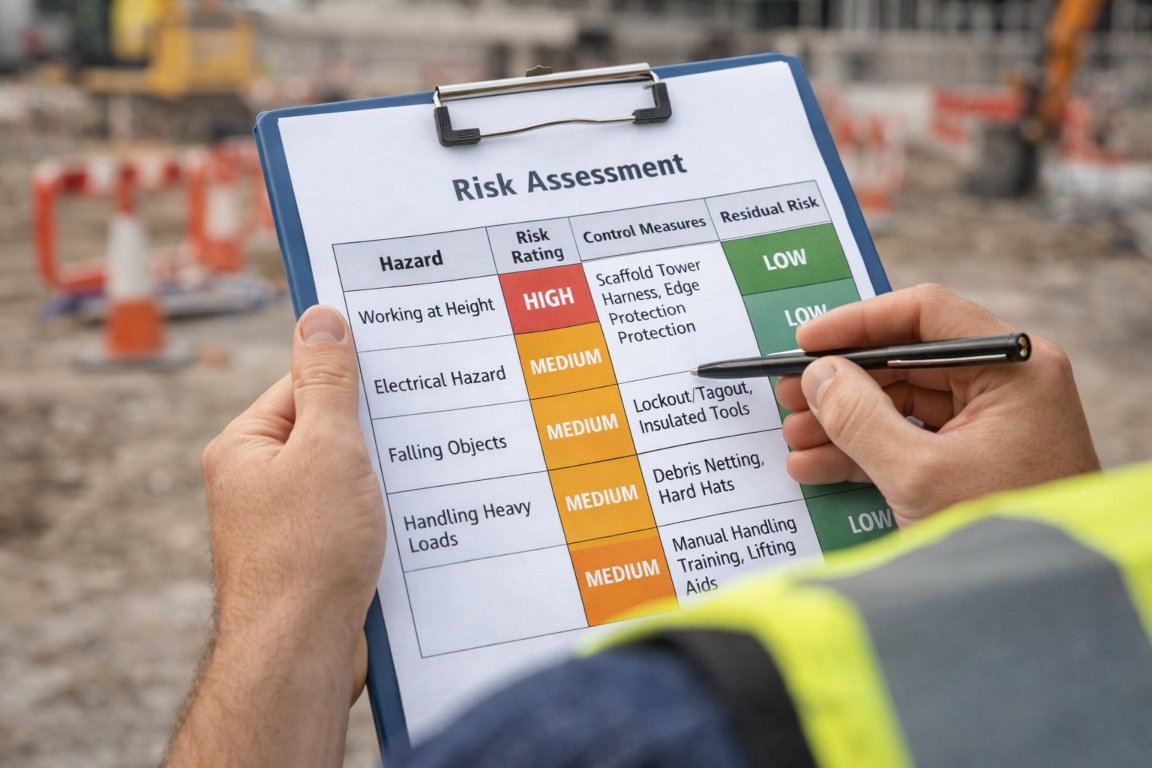
The risk assessment is the first half of your RAMS document. It identifies what could go wrong and what you are going to do about it. A thorough risk assessment should include the following sections.
Project and task details. Start with the basics: the project name, site address, client name, the specific task being assessed, and the date the assessment was prepared. Include the name and qualifications of the person who wrote it.
Hazard identification. List every significant hazard associated with the task. Be specific. Instead of writing working at height, write operatives working from a mobile scaffold tower at approximately 4 metres to install ceiling-mounted cable trays. The more specific you are, the more useful the assessment becomes.
Who might be harmed. Identify the people at risk for each hazard. This typically includes the workers carrying out the task, other contractors working nearby, members of the public, building occupants, and visitors to the site.
Existing control measures. For each hazard, describe what is already in place to manage the risk. This might include training, permits to work, physical barriers, PPE, or standard operating procedures.
Risk rating. Assess each hazard using a risk matrix that considers the likelihood of harm occurring and the severity of the potential outcome. Most RAMS use a simple 5x5 matrix that produces a risk score, which is then categorised as low, medium, or high.
Additional control measures. If the existing controls are not sufficient to reduce the risk to an acceptable level, describe the additional measures you will put in place. These should follow the hierarchy of control: eliminate, substitute, engineering controls, administrative controls, and PPE as a last resort.
Residual risk rating. After applying the additional controls, re-rate the risk to show the reduced level. This demonstrates that your control measures are effective.
What to Include in the Method Statement

The method statement is the second half of your RAMS. It takes the control measures identified in the risk assessment and builds them into a practical, step-by-step plan for carrying out the work safely.
Scope of work. Describe what the work involves, where it will be carried out, and the expected duration. Include any constraints or site-specific conditions that affect how the work will be done.
Sequence of operations. Break the work down into numbered steps in the order they will be carried out. Start with site setup and preparation, work through the main activity, and finish with demobilisation and clean-up. Do not skip steps that seem obvious.
Hazards and controls at each step. For every step in the sequence, identify the hazards present during that stage and describe the specific control measures that will be applied. Cross-reference these with your risk assessment.
Plant, equipment, and materials. List everything that will be used to carry out the work, including tools, machinery, access equipment, and materials. Note any inspection or certification requirements, such as LOLER inspections for lifting equipment.
PPE requirements. Specify the personal protective equipment required for each stage of the work. Be specific about the standard required — for example, EN 397 safety helmet rather than just hard hat.
Competence and supervision. State who will carry out the work, what qualifications or training they need, and who will supervise. Include CSCS card requirements where relevant.
Emergency procedures. Describe what to do in the event of an accident, fire, or other emergency. Include the location of first aid equipment, the names of trained first aiders, and the contact details for the emergency services and site management.
Sign-off section. Include a section where every worker involved in the task signs to confirm they have read, understood, and will follow the method statement. This is critical evidence in the event of an incident.
Common Mistakes to Avoid

Using a generic template without tailoring it. A RAMS for roofing work should look completely different from one for electrical installation. If your document could apply to any job on any site, it is not specific enough.
Vague control measures. Phrases like take care, be aware, and use appropriate PPE are meaningless. Every control measure should describe a specific, verifiable action.
Missing the sign-off. If your workers have not signed the RAMS before starting work, the document is not doing its job. An unsigned RAMS will not protect you in an investigation.
Not updating it. If the scope of work changes, the RAMS must be updated and re-briefed to the workforce. A RAMS written for the original plan that no longer reflects reality is a liability, not a safeguard.
Need Professional RAMS for Your Next Job?
If you need compliant, task-specific RAMS written by qualified health and safety consultants, our risk assessments and method statements service can help. We write tailored RAMS for contractors and businesses across the UK, with turnaround from one to three working days.
If you are a contractor needing RAMS for site access or pre-qualification, see our dedicated RAMS for contractors page for details and pricing.
