
What Does RAMS Stand For? A Clear Explanation for UK Businesses
If you work in construction, maintenance, or any industry where health and safety documentation is required, you will almost certainly come across the term RAMS. It is one of the most commonly used abbreviations in UK health and safety, but it is also one of the most frequently misunderstood.
This guide explains exactly what RAMS stands for, what the documents involve, when they are required, and how they help businesses stay safe and compliant.
If you already know what you need, you can request a quote for our professional risk assessments and method statements service. We write tailored RAMS for contractors and businesses across the UK.
What Does RAMS Stand For?
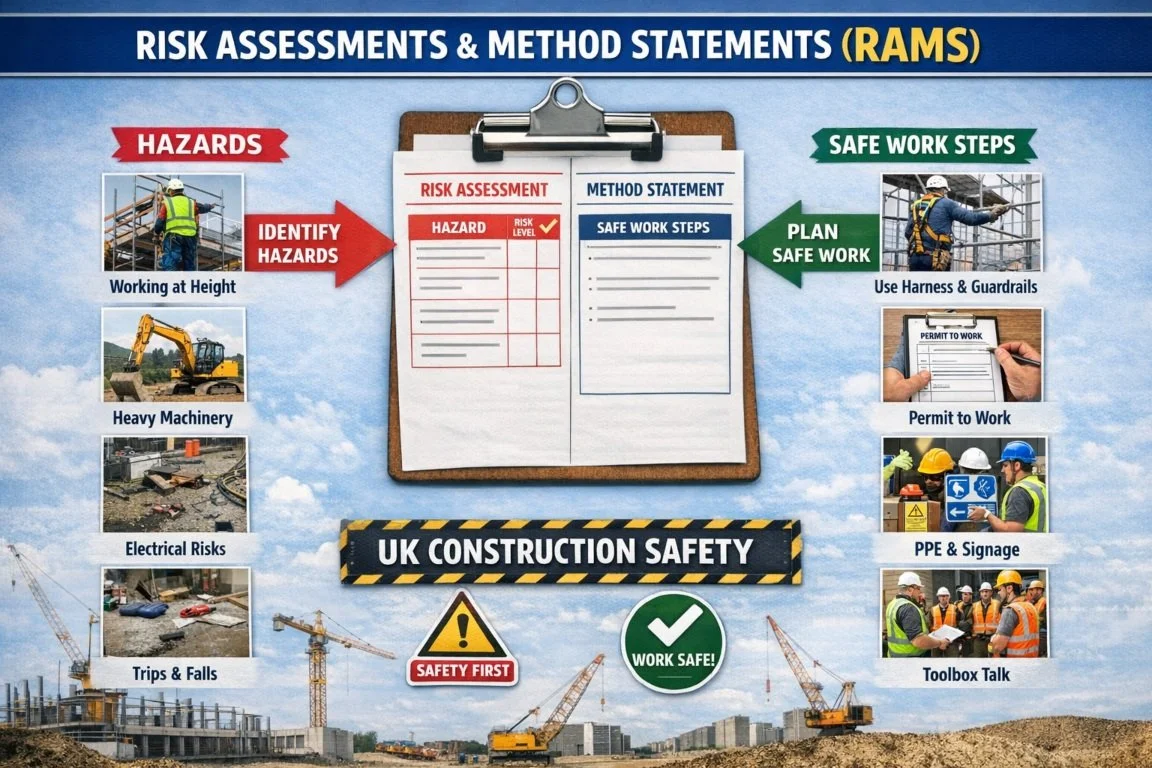
RAMS stands for Risk Assessments and Method Statements. It refers to two separate but closely related health and safety documents that are usually prepared together and submitted as a single package.
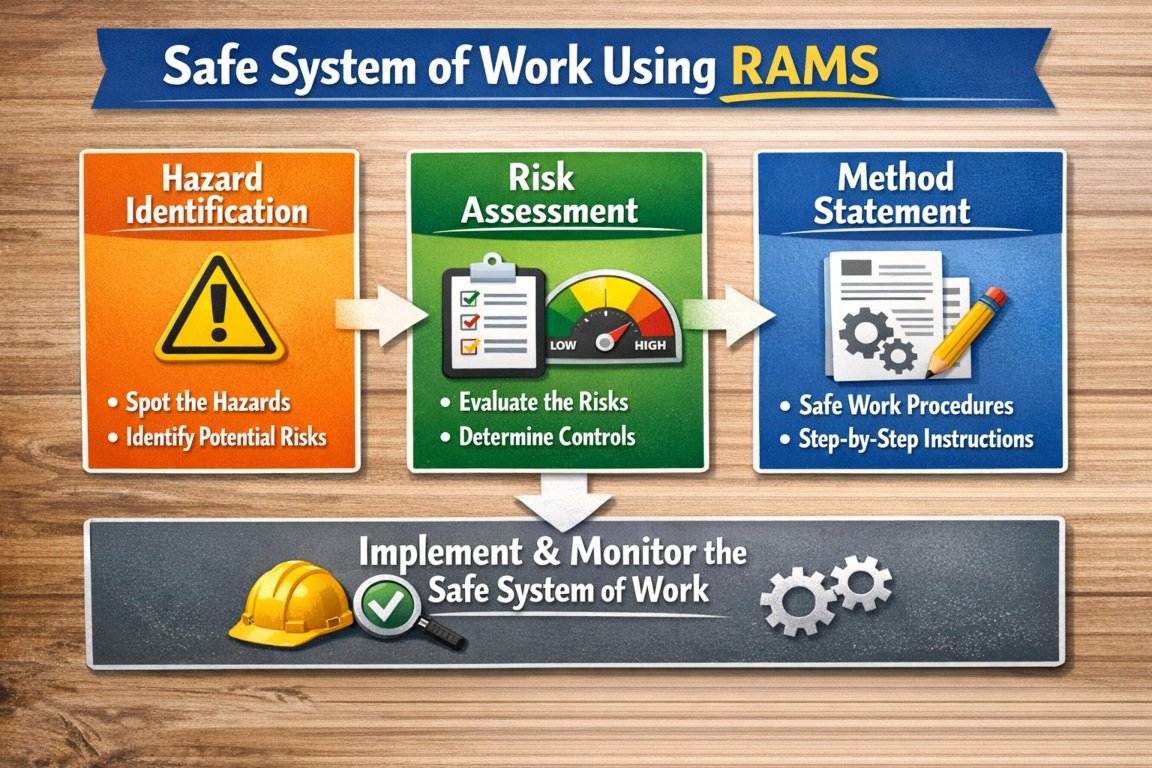
A risk assessment identifies the hazards associated with a specific task, evaluates how likely it is that someone could be harmed, and sets out the control measures needed to reduce or eliminate the risk.
A method statement describes step by step how the work will be carried out safely. It covers the sequence of operations, the equipment and materials to be used, the personnel involved, PPE requirements, and emergency procedures.
Together, these two documents form a comprehensive safety plan for a specific job or activity. They are sometimes referred to as a safe system of work.
Are RAMS a Legal Requirement?
Risk assessments are a legal requirement under the Management of Health and Safety at Work Regulations 1999. Every employer and self-employed person must carry out a suitable and sufficient risk assessment for any activity that could cause harm. If you employ five or more people, the risk assessment must be written down.
Method statements are not specifically required by name in UK law. However, the Health and Safety Executive recommends them as an effective way to plan and manage work safely, particularly for higher-risk activities. In practice, most principal contractors, clients, and commercial sites will not allow work to begin without RAMS.
Under the Construction (Design and Management) Regulations 2015, also known as CDM 2015, contractors must plan, manage, and monitor their work to ensure it is carried out safely. RAMS are widely recognised as the standard way to demonstrate compliance with these duties.
When Are RAMS Required?
RAMS are typically required in the following situations:
Before starting work on a construction site, especially where a principal contractor is managing the project. Before carrying out high-risk activities such as working at height, hot works, confined space entry, demolition, or lifting operations. When a client, landlord, or facilities manager requests them as a condition of site access. As part of a tender submission or pre-qualification assessment such as SSIP, CHAS, SafeContractor, or Constructionline. When introducing new equipment, substances, or working methods that have not been assessed before.
Even for lower-risk activities, having documented RAMS demonstrates professionalism and helps protect your business in the event of an incident or inspection.
What Should a RAMS Document Include?
A well-written RAMS document typically includes the following:
Project details including the site address, client name, and dates of work. A description of the task or activity being assessed. Identification of all hazards associated with the work. An assessment of the risk level for each hazard, usually using a risk matrix. Control measures to eliminate or reduce each risk. A step-by-step method statement describing how the work will be carried out safely. PPE requirements for all personnel. Emergency procedures and first aid arrangements. Details of competent persons, supervisors, and responsible individuals. Sign-off sections for workers to confirm they have read and understood the document.
For a detailed walkthrough, read our guide on how to write effective RAMS for construction and maintenance work.
RAMS vs Risk Assessments — What Is the Difference?
A common point of confusion is the difference between a standalone risk assessment and a full RAMS pack. A risk assessment identifies hazards and control measures at a general level. RAMS go further by adding a detailed method statement that explains exactly how the work will be done safely, step by step.
For most office-based or low-risk environments, a standard risk assessment is sufficient. For construction, maintenance, engineering, and other high-risk activities, RAMS are the expected standard.
We have written a separate article explaining the differences in detail. Read our guide on RAMS vs risk assessments to find out which one your business needs.
Who Should Write RAMS?
RAMS should be written by a competent person with sufficient knowledge of the task, the hazards involved, and the relevant health and safety legislation. This could be an in-house safety manager, a site supervisor with the right experience, or an external health and safety consultant.
The key requirement is that the person writing the RAMS understands the work being carried out and can accurately identify the risks and control measures. Generic templates downloaded from the internet are unlikely to be suitable or sufficient for your specific work activities.
At Tailored Safety Solutions, our qualified consultants write task-specific, client-ready RAMS for contractors and businesses across the UK. Every document is tailored to your exact work activities, not copied from a template. If you need RAMS for a specific job or contract, get in touch for a quote.

How Often Should RAMS Be Reviewed?
RAMS should be reviewed and updated in the following circumstances: at least once a year as standard, after any accident, incident, or near miss, when new equipment, processes, or chemicals are introduced, when staff roles or responsibilities change, when the working environment changes, and whenever a client or principal contractor requests an update.
RAMS are living documents. They should reflect current working practices and be communicated to everyone involved in the work before it begins.
Need Help With Your RAMS?
If you need professional RAMS written for your business, our team can help. We provide tailored risk assessments and method statements for contractors, construction firms, maintenance companies, and trades across the UK. Every document is written by qualified health and safety consultants and designed to meet the requirements of principal contractors, SSIP schemes, and UK safety legislation.
Contact us today to discuss your requirements or request a quote for our RAMS service.
